
How Strategy Moves When Work Is Organized Around Projects
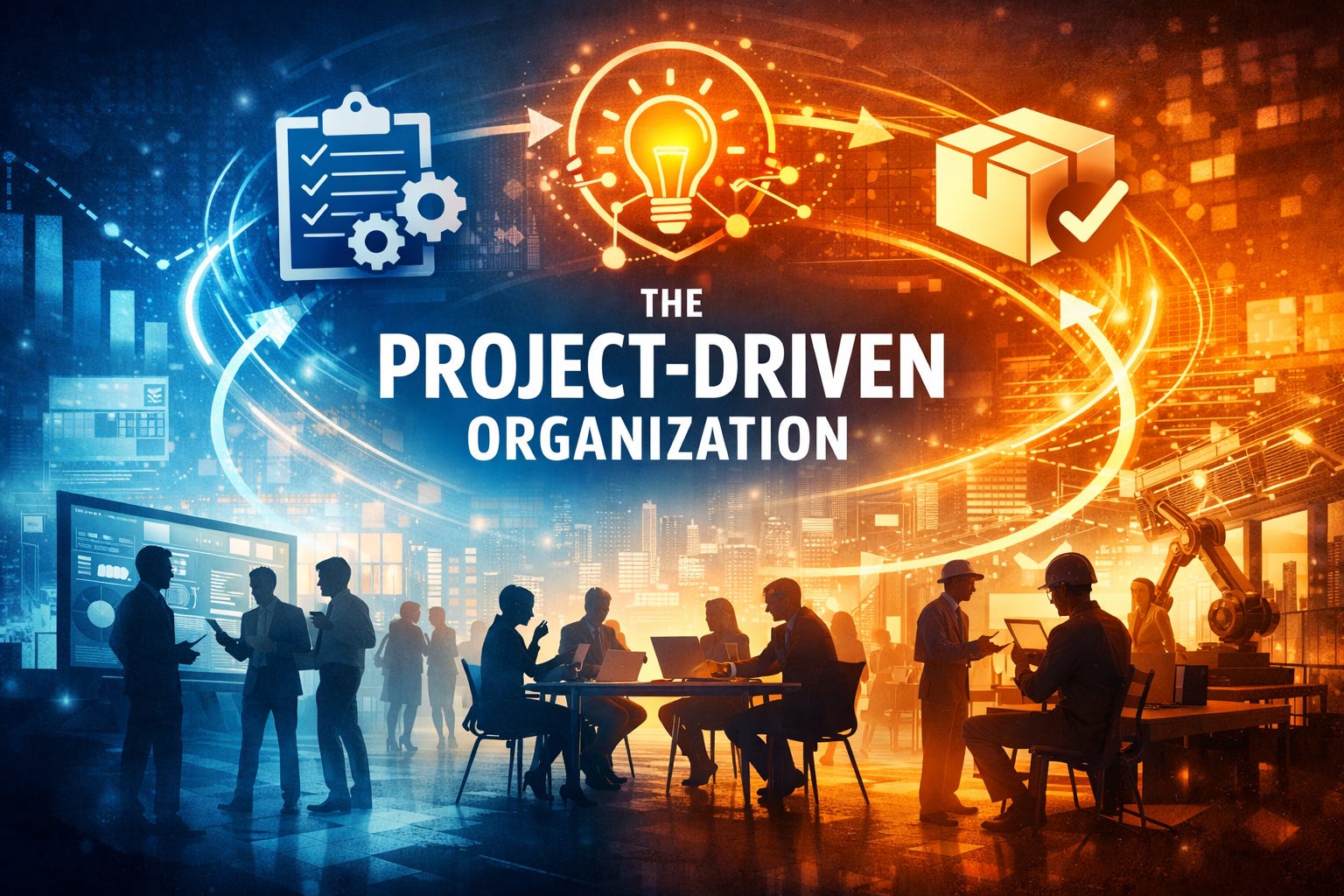
For decades, organizations have been designed around a stable set of assumptions. Work is predictable. Roles are durable. Value flows through clearly defined functional hierarchies. Those assumptions are no longer reliable. What has changed is not simply how work gets done, but how strategy is converted into action. Increasingly, strategy no longer lives primarily in planning cycles, operating models, or organizational charts. It lives in projects.
The project-driven organization reflects a recognition that value creation now occurs in bursts of focused effort rather than along linear functional pipelines. When customer needs shift faster than job descriptions can be rewritten, and when strategic opportunities emerge and fade within compressed time horizons, organizations built around static roles struggle to respond. Those that organize around projects gain an ability to mobilize talent, learn quickly, and translate intent into outcomes.
This does not mean that hierarchy disappears or that roles become meaningless. It means that hierarchy stops being the primary mechanism through which work is allocated and coordinated. In a project-driven organization, talent flows to the work rather than the work being forced through rigid structures. Authority follows accountability. Outcomes matter more than functional purity.
To make this tangible, consider a professional services firm as a constructed example, designed to illustrate the shift rather than describe a specific institution. In the traditional version of this firm, consultants are anchored to practices, staffed through informal networks, and evaluated largely on utilization and tenure. Projects exist, but they are treated as temporary assignments layered on top of a permanent organizational identity.
In the project-driven version of this same firm, the center of gravity moves. Practices still exist, but primarily as homes for capability development, mentorship, and standards. Strategic initiatives are explicitly defined as projects with clear objectives, timeframes, and success criteria. Consultants move across these initiatives based on the skills required, the problems being solved, and the value at stake. A consultant might contribute to a market entry effort, then shift to a data modernization engagement, and later join an internal offering development project, carrying insights from one context into the next.
The effect is not simply better staffing. Learning compounds. Expertise becomes portable rather than trapped. Junior consultants develop faster because they encounter varied problem spaces. Senior consultants focus less on defending territory and more on shaping outcomes. Strategy ceases to be something discussed at leadership offsites and becomes something expressed through coordinated project portfolios.
A second illustrative construct comes from private education, where the tension between tradition and innovation is particularly acute. Imagine a school that aspires to modernize learning, integrate data more effectively, and prepare students for an uncertain future, while still operating within a deeply departmental structure. Innovation is often delegated to committees or single roles, making progress slow and uneven.
In a project-driven version of this school, strategic priorities are framed as time-bound initiatives rather than permanent responsibilities. A curriculum evolution effort becomes a defined project, drawing together educators from multiple disciplines, admissions leaders, learning support staff, and technologists. A data initiative becomes another project, combining academic insight, operational knowledge, and external expertise. Participation is based on capability and interest rather than position on an org chart.
Teachers are not removed from classrooms, and leadership structures remain intact. What changes is how progress happens. Faculty who might never have collaborated find themselves working toward shared outcomes. Ideas move into action because there is a clear vehicle for doing so. Innovation stops feeling like an additional burden layered onto existing work and instead becomes embedded in how the institution advances. The school becomes more adaptive not by demanding more change, but by creating structures that make meaningful contribution possible.
A third construct comes from a product company, often assumed to be naturally project-oriented but frequently constrained by functional silos. In the traditional model, engineering builds, marketing positions, sales sells, and operations supports. Coordination happens through handoffs. Roadmaps look coherent on paper, yet execution lags as teams optimize locally rather than collectively.
In the project-driven version of this company, work is organized around product missions rather than functions. Each mission is treated as a project with end-to-end accountability, from discovery through launch and iteration. Teams are assembled dynamically, combining engineering, design, data, marketing, and commercial expertise from the outset. Success is measured by customer and market outcomes, not by the completion of functional tasks.
When a mission concludes, team members move on to the next priority, carrying lessons with them. Leadership focuses on sequencing and trade-offs rather than oversight of individual tasks. The organization becomes more disciplined, not less. Decisions about where to invest become clearer because capacity is visible and finite. Strategy expresses itself through what projects are funded, staffed, and sustained.
Across these examples, the same principle holds. The project-driven organization does not abandon structure. It reorients it. Hierarchies remain important for governance, continuity, and development. Projects become the primary mechanism through which value is created, tested, and refined. Work becomes legible in terms of outcomes rather than activities.
There is also a deeper cultural implication. When projects are the unit of progress, learning accelerates. Feedback arrives faster. People see the impact of their decisions in real contexts rather than abstract reviews. Knowledge moves horizontally across the organization rather than vertically through reporting lines. Over time, this creates an organization that is better at sensing, adapting, and acting.
This shift places new demands on leadership. Leaders must move from controlling resources to designing systems of flow. They must create clarity around priorities, enable movement without chaos, and accept that not all value emerges from permanent structures. This requires trust, discipline, and a willingness to let go of familiar forms of control.
The alternative is increasingly visible. Organizations that cling to static designs in dynamic environments experience a widening gap between strategy and execution. Change efforts feel exhausting rather than energizing. Projects become heroic interventions rather than repeatable mechanisms. People feel busy but disconnected from impact.
The project-driven organization offers a different path. Not a promise of simplicity, but a way to align how work is structured with how value is actually created. As complexity continues to rise and timelines continue to compress, the question is no longer whether organizations operate through projects. They already do. The question is whether they will design for that reality deliberately, or continue to force modern work through structures built for conditions that no longer apply.