
The Word We Hide Behind

There is a question I get asked often, usually with a tone of urgency: “How do we become more innovative?”
I understand why it comes up. Every organization feels the pressure. Markets shift faster than they used to. Technology doesn’t wait for permission. Leaders want to signal that they are moving forward, not standing still.
But I’ve come to believe that the question itself is part of the problem.
It depends on what we mean by innovation. And that ambiguity gives us an easy place to hide.
Over time, the word has been stretched to cover almost anything. I’ve seen organizations invest in innovation labs, run hackathons, appoint senior leaders with “innovation” in their titles, and redesign office spaces to feel more creative. On the surface, it looks promising. It signals intent.
And yet, very often, very little actually changes.
I say that carefully, because I’ve been part of those efforts myself. Early in my career, I was drawn to the energy of it. The whiteboards, the ideation sessions, the sense that something new might emerge. There is value in that energy. But energy alone is not transformation.
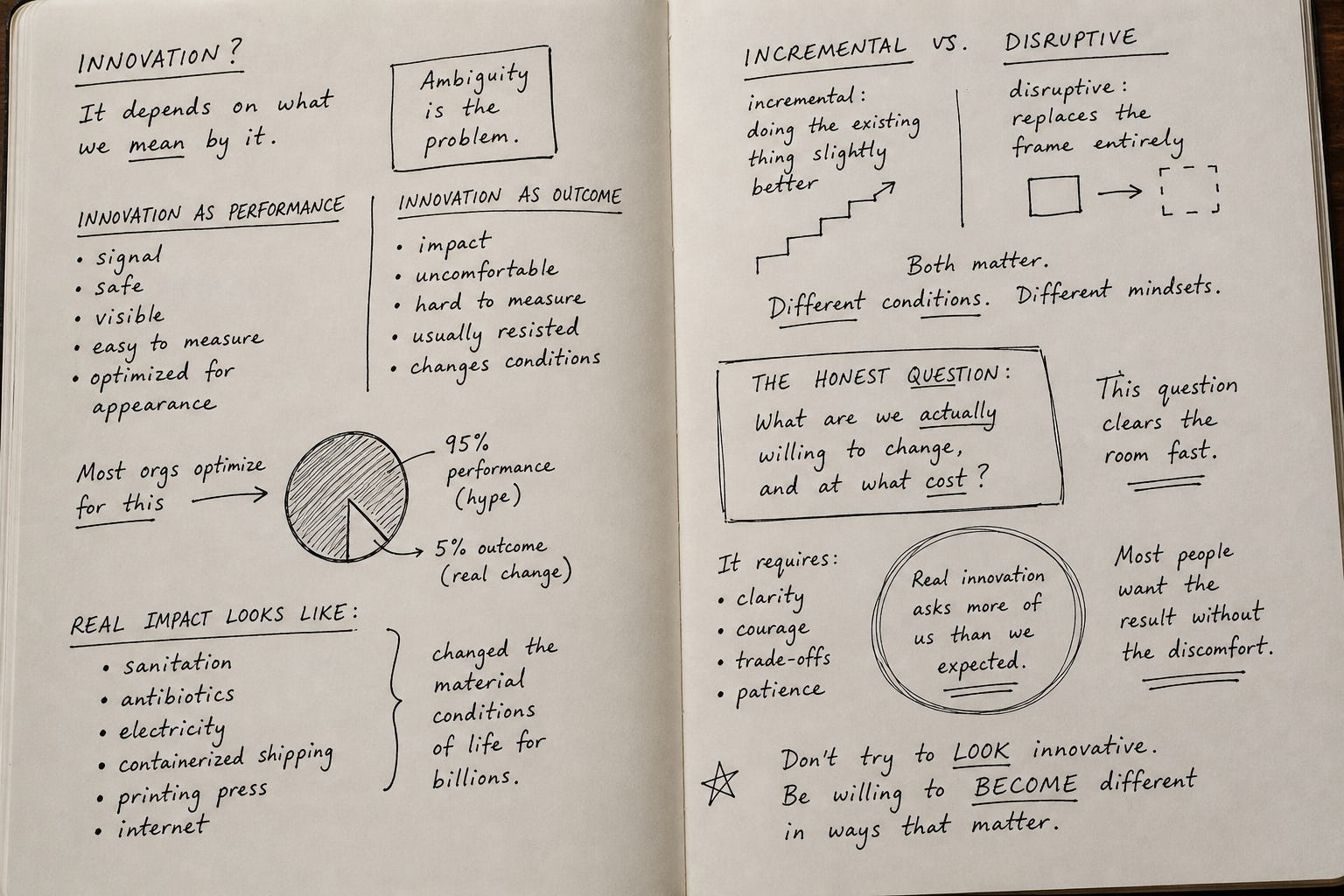
The more I’ve worked with organizations, the more I’ve come to see a clear distinction that rarely gets discussed openly: the difference between innovation as performance and innovation as outcome.
Performance is visible. It is safe. It gives people something to point to. A workshop held. A prototype built. A new initiative announced. These are not meaningless activities, but they are often optimized for appearance rather than impact.
Outcome is different. It is quieter at first. It is harder to measure. And it almost always comes with tension.
If we look at the changes that have truly reshaped industries and societies, they did not arrive as polished initiatives. They arrived as disruptions. Sanitation systems redefined public health. Antibiotics transformed medicine. Electricity reshaped entire economies. Containerized shipping rewrote global trade. The iPhone reshaped modern life in ways nobody predicted.
None of these fit neatly into a quarterly innovation report.
More importantly, they were not comfortable. They displaced existing models. They forced organizations and individuals to let go of what had worked before. And they required decisions that, at the time, likely felt risky or even unreasonable.
That pattern still holds.
Within organizations, the initiatives that have the potential to truly matter are often the ones that feel the most inconvenient. They challenge current revenue streams. They expose inefficiencies. They force conversations that teams would rather avoid.
It is much easier to improve what already exists. And to be clear, incremental improvement is valuable. Refining processes, enhancing products, optimizing performance, these create real economic value and should not be dismissed.
But incremental change and fundamental change are not the same thing. They require different mindsets, different structures, and, most importantly, different levels of willingness.
Where I see organizations struggle is when those two ideas are blended together under the single banner of “innovation.” A new dashboard, a slightly improved workflow, or a marginally better customer experience gets labeled as innovation, while the deeper shifts, the ones that could redefine the organization’s trajectory, remain untouched.
Not because they are invisible, but because they are difficult.
So when I’m asked how to build an innovative organization, I find myself gently reframing the conversation.
A more honest question is this: What are we actually willing to change, and at what cost?
That question tends to slow things down. It removes the abstraction. It forces specificity.
Are we willing to rethink our core business model if the data suggests it?
Are we willing to invest in capabilities that may not show immediate returns?
Are we willing to disrupt parts of our own organization before someone else does?
These are not easy questions. In fact, in many rooms, they create a kind of silence that tells you everything you need to know.
And that is not a failure. It is clarity.
Because once you understand what you are truly willing to change, you can begin to act with intention rather than aspiration.
In my experience, the organizations that make meaningful progress are not the ones that talk the most about innovation. They are the ones that make a small number of deliberate, sometimes uncomfortable choices and follow through on them.
They do not try to look innovative. They try to become different in ways that matter.
If there is a role I try to play in those moments, it is not to bring in more ideas or more frameworks. It is to help leaders see the trade-offs clearly, to create the conditions where honest decisions can be made, and to stay with them as those decisions take shape.
That work is less visible than a launch event or a lab opening. But it is where real change tends to begin.
And perhaps that is the point.
Innovation, in its most meaningful form, is not something we declare. It is something we are willing to endure, shape, and see through, even when it asks more of us than we expected.