
What a Mastery-Based School Day Could Look Like
In an earlier Shape of Tomorrow article, I spent time deconstructing one of the most deeply embedded assumptions in schooling: that time is fixed, and learning is variable. We organize the school day, the semester, and the year around a rigid calendar, move everyone through the same material at the same pace, and then accept uneven learning outcomes as inevitable. The system is considered fair because it is consistent, even if the results are not.
Mastery-based learning begins by rejecting that premise. It assumes that learning is the constant and time is the variable. The objective is not to finish a unit on schedule but to ensure that students actually develop proficiency. Once a school commits to that idea, the school day itself has to be redesigned. Not cosmetically, but structurally.
In a mastery-based environment, the schedule is no longer anchored to pacing guides. It is anchored to clearly defined competencies. Subjects are broken into observable skills and concepts with explicit criteria for what counts as mastery. Expectations are visible from the start through rubrics, exemplars, and performance tasks. Proficiency is not inferred at the end of a grading period. It is demonstrated as students move through the learning progression.
This clarity is what allows time to flex without lowering standards. When a student has not met the agreed-upon threshold for mastery, the response is not to move on because the calendar demands it. The response is to adjust the use of time, provide additional support, and create another opportunity for learning and feedback.
The daily experience of students reflects this shift. Most days still include moments of whole-group instruction. Teachers introduce concepts, frame inquiry, or facilitate discussion. But these moments occupy a smaller portion of the day than in traditional models. The majority of learning happens in extended work blocks where students are operating at different points along a continuum. Some are revisiting prerequisite knowledge. Some are practicing. Some are attempting to demonstrate mastery. Teachers circulate, work with small groups, and conference individually based on real-time evidence rather than assumptions about where students should be.
A defining feature of the mastery-based day is protected flexible time. Many schools build in a daily or near-daily flex block that allows students to move where they are needed most. That might be targeted reteaching, reassessment, project work, or enrichment. Choice exists, but it is bounded by data and coaching. Advisory time plays a central role here. Students regularly review their progress against competencies, set goals, and make intentional decisions about how to use their time. Being ahead in one subject and behind in another is not treated as a problem to be solved. It is treated as a normal part of learning.
Flexible time does not mean unstructured time. Progress triggers movement. When students demonstrate mastery, they advance to the next set of learning experiences. Short, frequent checks for understanding inform how students are grouped and where they are scheduled during flex periods. Reassessment is not an exception or a concession. It is deliberately designed into the timetable so that learning on the second or third attempt is valued, not penalized.
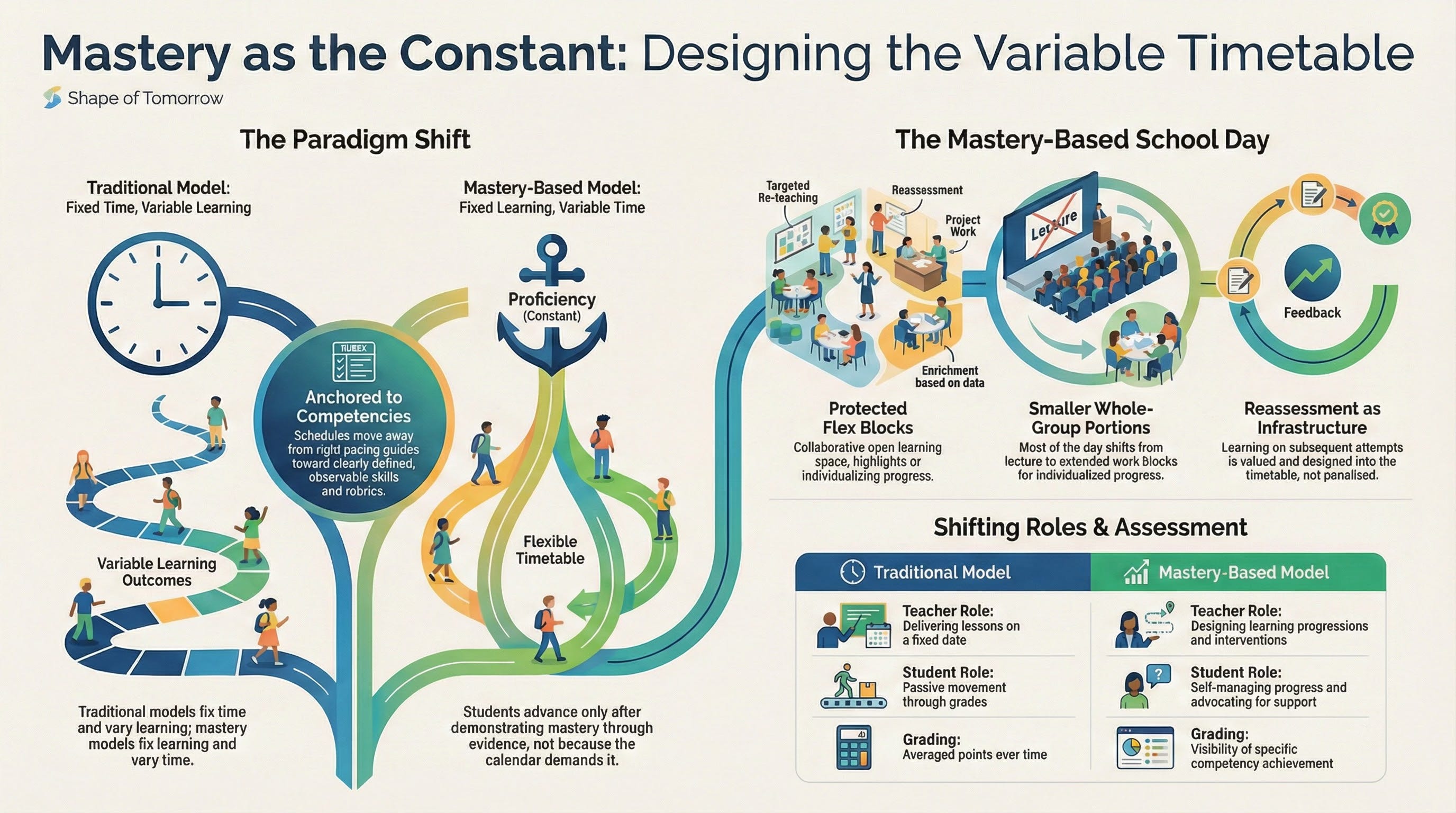
For teachers, this model changes the nature of the work. Planning shifts from preparing lessons for a specific date to designing learning progressions tied to competencies. Time becomes an intervention tool. Instead of trying to differentiate within a single class period, teachers can deliberately allocate more time tomorrow or next week to the students who need it most. Formative assessment becomes essential infrastructure, because it drives how time and support are allocated. This approach is demanding, particularly at the start. It requires collaboration, shared definitions of mastery, and often a rethink of roles and responsibilities. But it also aligns teaching effort much more directly with student learning.
For students, the experience is both more transparent and more demanding. The familiar experience of passing without really understanding fades. Progress is visible and tied to specific competencies rather than averaged grades. With greater agency over parts of their schedule comes greater responsibility. Students learn to plan, prioritize, and advocate for support. The timetable itself becomes a tool for developing self-management and metacognitive skills.
Most schools do not need, and likely should not attempt, a full mastery-based timetable all at once. The more effective approach is to treat this as a series of disciplined schedule experiments. Some schools start by adding a single protected flex block. Others pilot mastery-based pacing in one subject or grade level. Almost all benefit from beginning with the unglamorous but essential work of clarifying competencies and agreeing on what proficiency actually means.
The deeper shift is philosophical. When schools decide that proficiency is non-negotiable but time is adaptable, they start making different design choices. They create space for students to try again. They protect the minutes that matter most. And they begin to treat the master schedule not as a constraint to work around, but as a strategic design space for better learning.