
The Innovations We Recognize. And the Ones We Miss.

A reader sent me a note after one of my recent articles about innovation. It was thoughtful and candid in a way I always appreciate.
He agreed with the big examples I had used. Sanitation, antibiotics, electricity. No debate there. Those clearly reshaped life.
But then he asked, “I’m not sure I see how the iPhone belongs in that same category.”
It’s a fair question. In fact, it’s the kind of question I wish more leaders would ask out loud.
Because on the surface, the iPhone doesn’t look like those other innovations. It didn’t extend life expectancy in the way antibiotics did. It didn’t solve a visible constraint like electricity. It feels, at least initially, like a refinement. A better device. A more elegant experience.
I’ve had that same reaction myself at different points.
But the more I’ve sat with it, especially working with organizations trying to navigate change, the more I’ve come to see that we may be applying the wrong lens.
We tend to look for innovation in its first-order effects. What does it do directly? What does it improve? What problem does it solve?
By that definition, the iPhone can look incremental.
What it actually did was shift the conditions around everything else.
Before the iPhone, computing was something we went to. It was deliberate. Bounded. You opened a laptop, logged in, completed a task, and stepped away.
After the iPhone, computing became continuous. It moved with us. It became ambient.
That shift alone is easy to underestimate. But it didn’t stop there.
The interface became intuitive enough that you didn’t need to be technical to engage with it. The internet became something you were always connected to, not something you accessed occasionally. Software stopped being something you installed and became something you discovered and used instantly. Multiple devices collapsed into one. And quietly, almost invisibly, behaviour started generating data at a scale we hadn’t seen before.
None of these changes, on their own, feels like antibiotics or electricity.
But taken together, they created a different operating environment.
And that’s where things start to get interesting.
No one set out to create the gig economy when the iPhone launched. No one was aiming to redefine how we communicate to the point where messaging would overtake voice. No one designed for a world where attention would become one of the most contested resources.
And yet, here we are.
Entire industries reshaped. Business models rethought. Expectations shifted, often without us fully noticing when the change actually happened.
I find that pattern shows up often in the organizations I work with. There’s a tendency to focus on the visible layer of innovation. The features. The initiatives. The programs that can be pointed to and measured.
Those matter. But they’re rarely where the real shift occurs.
The more meaningful question is what changes because those things exist.
Does the organization behave differently? Do customers engage differently? Do decisions get made differently?
That’s a harder conversation. It requires a bit more honesty. And sometimes it surfaces trade-offs that aren’t immediately comfortable.
But it’s also where the signal tends to be.
With something like electricity, we can see the before and after clearly. The same is true with antibiotics. Time has done the work of clarifying their impact.
With the iPhone, we’re still inside the change. That makes it harder to step back and see it for what it is.
But if you look closely, the shifts are there.
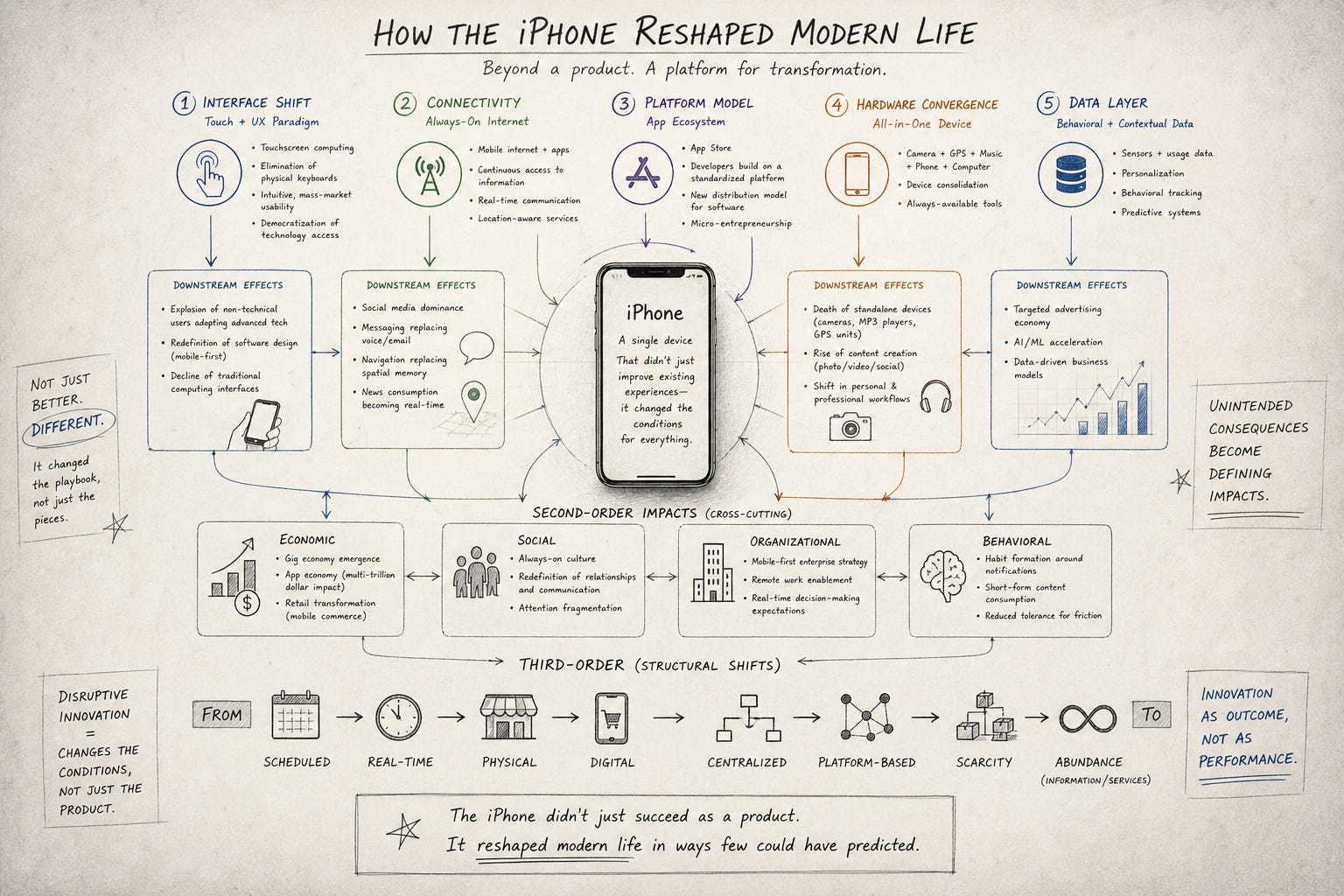
We moved from scheduled interactions to real-time ones. From physical experiences to digital overlays. From centralized control to platform-based ecosystems. From limited access to information to something much closer to constant availability.
Those are not small adjustments.
They’re the kind of changes that alter how organizations operate and how people move through the world.
When I read the reader’s question, I didn’t see it as disagreement. I saw it as exactly the kind of instinct that leaders need to sharpen.
Because the challenge is rarely recognizing innovation after it has reshaped everything. We’re all quite good at that in hindsight.
The harder work is recognizing it while it’s still unfolding. When it doesn’t yet look like the examples we’re comfortable with. When it sits somewhere between improvement and transformation.
Those are the moments I find most interesting in leadership conversations. Not because there’s a clear answer, but because there’s an opportunity to look at something a bit differently and ask a more precise question.
Not “is this innovative?” but “what would this change if it actually took hold?”
That question tends to open up a different kind of discussion. And in my experience, it’s often where more meaningful decisions start to take shape.